



JDS中国项目概述大学信息
- URL of Graduate School (English)
- https://www.icu.ac.jp/en/academics/gs/about/index.html
- Name of Course/Program
- Public Policy and Social Research Program
- URL of Course/Program (English)
- https://www.icu.ac.jp/en/academics/gs/ma/
- Degrees
- Master of Arts in Public Economics
- Credit and years needed for graduation
- 30 credits/ 2 years
Features of Graduate School
ICU’s Mission and Commitments
International Christian University holds as its mission the establishment of an academic tradition of freedom and reverence based on Christian ideals as well as the cultivation of internationally minded citizens who perform service to God and humankind and make contributions to lasting peace. As a university founded through international cooperation, ICU pursues three commitments expressed in the university's name: International, Christian and Academic Commitments.
International Christian University (ICU) was founded with the cooperation of both Japanese and North American leaders and educators. The first students entered ICU in 1953 when the College of Liberal Arts was opened. ICU is the first Liberal Arts College established in Japan and is well known today for its academic excellence. Japan University Ranking 2025 put together by the British educational magazine the Times Higher Education (THE) was released on April 3, 2025. ICU was ranked 11th overall and first among private universities in Japan.
Outline of Graduate School of Arts and Sciences
ICU’s Graduate School opened in 1957, and it currently has four master’s programs: (1) Education and Psychology, (2) Public Policy and Social Research, (3) Comparative Culture, and (4) Natural Sciences. The graduate school also has a doctoral program.
Attention Given to Each Student
Since the graduate student body is relatively small compared to the size of our faculty, every student has the advantage of enjoying the attention of faculty members. ICU has a policy for faculty members to set aside at least two hours each week as office hours when students can visit faculty members for any reason. This time for interaction is available in addition to the regular mentoring
and academic advising that graduate students receive related to their courses and/or thesis.
International Dimension
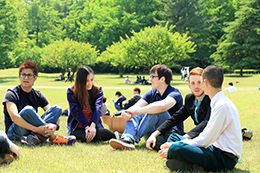
Students from many countries study in ICU's graduate school. Many students appreciate this international diversity because they can learn from each other. Since 2002, ICU's graduate school has accepted approximately 10 students every year as “Rotary Peace Fellows.” They come from countries all around the world. Like many JDS Fellows, many Rotary Peace Fellows possess professional working experience before they enter ICU's graduate school. Bringing together students with diverse backgrounds and experiences provides students with great opportunities to learn from each other.
ICU's international commitment is reflected in our diverse faculty. Roughly 40% of our fulltime faculty members are non-Japanese. They come from 19 different countries. Some faculty members have work experience in international organizations such as the Asian Development Bank (ADB), the World Bank, JICA and various United Nations (UN) programs and agencies.
Learning Environment
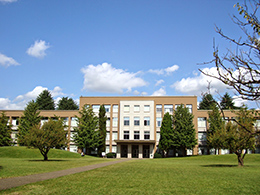
ICU is set in a serene, wooded campus in suburban Tokyo. This picturesque campus helps you revive your tired minds and bodies from intensive studies. At the same time, one can readily access central Tokyo, which is Japan’s business center and government seat. It takes only 30 minutes by public transportation to get to central Tokyo from the campus. Thus, ICU offers easy access to many government offices, UN agencies, and NGOs/NPOs as well as opportunities to develop a network with leading scholars and practitioners.
Bilingualism
ICU practices bilingualism; thus official documents are always written in English and in Japanese. In the Public Policy and Social Research program, roughly 80% of all classes are taught in English. For JDS Fellows who need to strengthen their English language skills, we offer a course entitled “Academic English” taught by our English language instructors. JDS Fellows who already have a high level of academic English has an option of taking advantage of our rigorous Japanese Language Program (JLP) if they desire to do so.
Features of the Course/Program
Objective of the Program:
The Public Policy and Social Research program aims to enable students to master advanced levels of learning in public policy and related social science disciplines. The program also helps students to develop analytical and research skills necessary to be effective researchers and practitioners.
Overview of the Program:
The Public Policy and Social Research program offers five areas of concentration in the social sciences: (1) Politics and International Studies, (2) Social and Cultural Analysis, (3) Media and Language, (4) Public Economics, and (5) Peace Studies. These academic fields do not stand alone as completely independent areas of study; some areas interrelate with one another in terms of theoretical and/or methodological approaches. Thus, although JDS China Fellows will choose Public Economics as their area of concentration, students are encouraged to embrace an interdisciplinary attitude towards their research topics. After two years of study at ICU, JDS China Fellows are expected to obtain a degree of Master of Arts in Public Economics.
Features of the Master’s Program
The expected outcomes of program participants are as follows:
(1) Students will develop the ability to conduct research and reach a deep and broad understanding of issues of utmost importance that JDS China Fellows may want to examine. These issues may include foreign policy, national security, the Belt and Road Initiative, Sino-Japan relations, Sino-US-Japan relations, improvement of administrative capabilities, regional development, and other issues related to China.
(2) Students will be able to strengthen their problem-solving abilities by learning how to apply theory to practice.
(3) Students will be able to form close relationships with former JDS China Fellows who studied at ICU. More than 40 JDS Fellows from China have graduated from ICU.
Necessary Curriculum to Obtain the Degrees
Courses taught through English language for the 2026 academic year (English Course)
Each student needs to obtain at least 30 units of credit in order to graduate with a master’s degree. Specifically, each student is required to obtain the following credit units (Each type of course is described below the table):
| Required units | Course Types |
|---|---|
| 2 units of credit (1 course) | Graduate School-Wide Courses |
| 4 units of credit (2 courses) | Program Foundation Courses |
| 8 units credit (4 courses) | Specialization Courses from each concentration area |
| 6 units of credit | Research Guidance |
| 6 units of credit (3 courses) | Foundation Courses, Specialization Courses in a related field(s), or Research Guidance |
| 4 credits (2 courses) | Graduate School courses of any type |
(1) Graduate School-Wide Courses
Through these courses students can acquire the basic knowledge and skills necessary to be successful in the master’s program. For example, the course entitled “Writing for Researchers (English)” helps graduate students to learn about important aspects of professional writing that are common to most academic fields. We also offer “Academic English” (for the first year) and “Academic English for Research” (for the second year) that are designed specifically for JDS Fellows. Through these courses, students can develop not only their writing skills but also the skills necessary for reading, discussion and presentations. In a course entitled “Field Research and Professional Learning,” students pursue practical engagement with society through participation in development projects, internships with government service and NGOs/NPOs, visits to companies and schools, and conducting fieldwork.
(2) Foundation Courses
The course entitled “Public Policy” teaches various theoretical approaches in studying public policy. In “Microeconomics,” students will study the decision making of individual agents such as households and firms and how they interact in the market. Students are also encouraged to take the course entitled “Research Design and Methodology,” which teaches how to design and conduct an academic research project. There are many other foundation courses.
(3) Specialization Courses
Within the Public Economics concentration area, students choose either economics or business administration as their field of specialization. Students in economics are required to take specialization courses in economics, while students in business administration choose relevant courses from business administration, accounting, and/or finance.
(4) Research Guidance
Each graduate student is assigned to a faculty advisor. The advisor advises students regarding their research necessary for their master’s thesis. Although the advice depends on the professor and on the stage of the student’s research, the advisor typically helps students to choose an appropriate research topic, conduct a literature review, select an appropriate research method(s), analyze data, and write the thesis.
(5) Foundation Courses and Specialization Courses in a Related Field(s)
Students can take any Foundation and/or Specialization courses that are offered in concentration areas other than their own. This flexibility enables students to learn various perspectives on topics that interest them.
Additional Information
(1) JDS Lecture Series
This lecture series brings outside experts to ICU so that students can learn about regional issues. Past lectures addressed topics such as China’s foreign policy in the Pacific, China’s Science Diplomacy in the SCS, Soft power and Public Diplomacy, the TPP and Regional integration, Philippino Politics, and Sino-U.S. relations.
(2) Domestic and international academic conference(s)
Students are encouraged to present their research findings at domestic and/or international conferences. While the availability of conferences may change year by year, JDS Fellows in the past presented their research findings to their peers and/or senior scholars at various conferences so that they can receive invaluable feedback. These conferences also give students an opportunity to listen to research presentations from other scholars and to develop domestic and/or international networks.
(3) Educational exchange with local universities
ICU has agreements for educational exchange and credit transfer with the United Nations University Institute for the Advanced Study of Sustainability (UNU-IAS) and Tokyo University of Foreign Studies. JDS Fellows can take courses offered at these universities and have units of credit (up to 15 units) transferred to their transcript at ICU.
Note: For specific information regarding ICU’s courses and their syllabi, check the following link:
https://campus.icu.ac.jp/public/ehandbook/SearchCourseAndSyllabus.aspx?lang=e
Select “MASTER” and “2025.” And then, choose all terms and click “SEARCH.” Finaly, select “Public Policy and Social Research Program” for GS program. Then, you should be able to see the list of all courses which are offered within the Public Policy and Social Research program in AY2025.
Whether a master's thesis is required as a requirement for completion/degree acquisition (and supplementary information regarding the requirement of a master's thesis)
Submission of Master’s thesis is one of the graduation requirements.
List of Faculty members capable of guiding JDS China Fellows and their Research Specialities
For the list of faculty members who may become academic advisors for JDS China Fellows, take a look at the following site:
https://www.icu.ac.jp/en/academics/gs/faculty/index.html
Based on their research proposal, each student is assigned to an academic advisor who will help guide the student’s study and research. In the third term of the first year, each student must submit to the Graduate School Dean a tentative title of the thesis approved by the student’s advisor.
Academic Schedule
Facilities (ex: Library, PCs, Gymnasium etc.)

(1) Dormitories
ICU has a dormitory for graduate students on campus. Some single rooms are available for graduate students. For more details, see: https://www.icu.ac.jp/en/campuslife/dormitories/
(2) Library
The ICU library, located at the center of the campus, currently maintains a collection of 445,367 books in Japanese, 337,654 foreign books, and 5,621 journal subscriptions (including e-journals). Our library is renowned as one of top-ranked libraries in Japan for the high number of items checked out per student.
(3) Sports Facilities
There are two gymnasiums on campus. Physical Education Center A, which was completed in 2018, houses the main court, a studio, and seminar rooms. Physical Education Center B, which was completed in 1972, houses rooms for ball games, martial arts, and weight training. Other physical education facilities include a swimming pool and the Central Locker Building, which houses locker rooms and shower rooms. In addition, there are also roofed tennis courts, a baseball field, a soccer/rugby field, and an archery range.
(4) Club Activities
ICU has many club activities (extracurricular activities), which are open to all students. They include sport-related activities as well as cultural activities. Cultural club activities include modern jazz, classical music, Japanese tea ceremony, Japanese traditional dance, English debate, and others.
(5) Counselling
ICU has a Counseling Center. Counselors are available to discuss psychological issues with students and help them deal with personal concerns. Some counselors speak English.
(6) Health Services
Consisting of the university physician and nurses who can speak English, the Health Care Office (HCO) provides some basic medical services for students, faculty and staff.
Advice for Graduate School Applicants
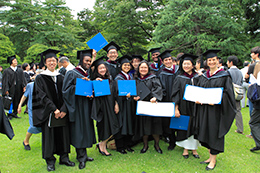
More than 40 JDS Fellows from China have graduated from ICU with a master’s degree. As this record indicates, the Public Policy and Social Research program at ICU offers valuable opportunities to Fellows from China to be trained as a researcher and as a professional. Our curriculum and faculty members’ guidance prepare JDS Fellows for the challenges they will face as future leaders and policy makers so that, when they can return to their home countries, they will be able to fully contribute to the further development of their country.
